
Bionic Limbs
As orthopaedic medicine continues to make great strides, bionic limbs in small animals are becoming a reality. The same surgery that has allowed humans to regain the use of their limbs after amputation can now be used on animals.
This surgery, called osseointegration, is at the forefront of veterinary medicine. As a veterinary surgeon, I believe that osseointegration offers great promise for treating animals with amputated limbs.
I have worked alongside the human group pioneering this procedure, Osseointegration Group of Australia, to establish osseointegration surgery at my veterinary hospital, with great success.
I am excited to be at the forefront of this field. With my expertise in veterinary orthopaedics,
I hope to develop my skills and expertise and make bionic limb replacements for dogs and cats more widely available in Australia and the world.
What is osseointegration surgery?
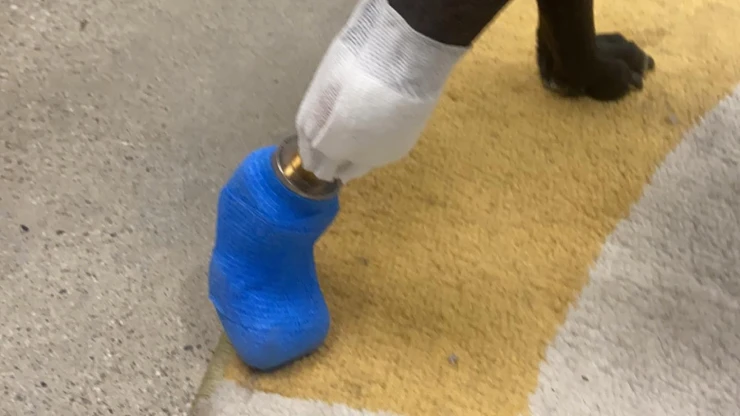
Osseointegration is a surgical procedure where a metal implant is inserted directly into the bone of an amputated limb. An external prosthesis (foot) can then be directly attached to the implant via a specialised adaptor.
The advantage of osseointegration is that it eliminates the need for external connections and straps. It also offers greater stability and greater sense of self movement and body position (proprioception).
What are the benefits of bionic limbs?
One of the benefits of osseointegration surgery is that it does not rely on external attachments like straps or harnesses to keep the prosthetic in place. This means that pets who undergo osseointegration surgery can move around more freely and naturally, without having to worry about their prosthetic coming loose or causing them discomfort.
The bionic limbs we design are custom-made and meant to last for the pet’s lifetime. Because the bionic limb components are osseointegrated directly into the bone, the potential for a secure limb that offers natural movement is increased.
How do I know if bionic limb surgery is right for my pet?
Bionic limb surgery in cats and dogs is currently considered experimental. It’s imperative that pet owners consider all their options before making a decision about the procedure for their pet.
At my clinic, I work with pet owners to understand their concerns and goals for their pets. We discuss the risks and benefits of bionic limb surgery. We also discuss potential complications of the surgery and the continuing care needed to maintain the prosthetic.
Ultimately, it’s up to each pet owner to decide whether or not bionic limb surgery is suitable for their pet. As an experienced veterinarian and advocate for animal welfare, I always encourage my clients to consider all of the options available before making a final decision. My goal is to help your pet live a healthy and happy life.

Custom-designed bionic limbs that offer greater flexibility and movement
To establish bionic limb surgery at my veterinary clinic, I collaborated with doctors who are experts in osseointegration for people.
To perform this surgery on dogs we adapted the Osseointegration Prosthetic Limb (OPL) system used in humans, which we called Vet-OPL.
The Vet-OPL system is made up of inner and outer components. The inner component is a stem made of highly porous titanium. The titanium resembles cancellous (hard) bone which allows the bone to grow inside the surface of the implant making it stronger and more stable.
The outer part is a prosthetic limb made of 3D printed high-density plastic and looks like a shoe. The shoe is attached directly to the stem with a dual adaptor. The adaptor is designed to minimise friction between the bone and soft tissue that surrounds the bone and is made of titanium niobium which has antibacterial properties.
All parts of the Vet-OPL were custom designed and manufactured for each individual animal. CT scans were used to measure the amputated limb. 3D modelling software was then used to scale down the human OPL system and reconfigure it for use in a dog.
I have performed two bionic limb surgeries on dogs with great success. The dogs were able to walk normally almost immediately after surgery, and have been able to run, play and live an active and healthy life.

Will the bionic limb wear out?
The foot (shoe) component of the limb wears out and needs to be periodically changed. This involves unclamping the shoe and replacing it. How often depends on how active the animal is. Active animals need their foot changed every month. Less active animals may only need their foot changed once or twice a year.
What is the success rate?
Because this is pioneering surgery, the long-term success of bionic limbs is still not clear. However, bionic limb surgery in humans, based on our procedure, has a success rate of approximately 70% and we anticipate the same success rate in animals.
However, the success rate is limb and bone specific. At my clinic, I have only performed surgeries on the hind limbs of large dogs.
What are the potential complications of bionic limbs?
Like any surgical procedure, complications can arise from bionic limb surgery and some can be serious. Complications include but are not limited to: infection, breakage or loosening of the implant, fractures or the need for revision surgeries. Complications can also occur with the ‘shoe’ component that needs to be replaced e.g. replacement of the foot component due to wear.
How long is the recovery after surgery?
As recovery varies between animals, we manage recovery on a case-by-case basis. Our preferred approach is to board the animal for a period of time at the veterinary hospital after the surgery. This allows us to carefully manage the initial stages of recovery before sending the animal home.
